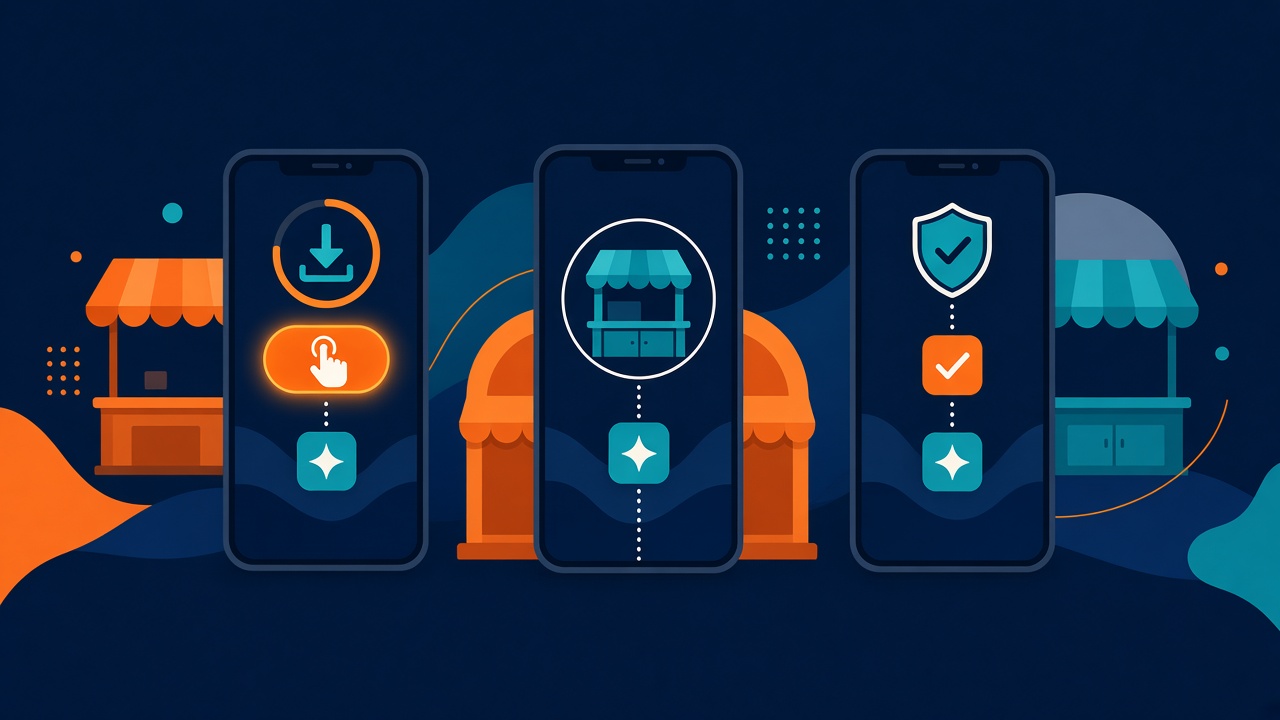
From 1 December 2026, Google will let approved third-party Android stores offer a more Play-like install path in many countries. Users of those stores will be able to install an app with one tap, and the stores will be able to update apps in the background, on devices running Android 17 QPR2 or later.
That programme is called Registered App Stores. It is optional, it is aimed at store operators rather than at every game team, and it does not work the same way everywhere. Google's developer FAQ, updated on 20 November 2026, splits it from a separate, US-only programme for third-party stores inside Google Play. The EU already has Digital Markets Act rules on alternative distribution and payments. India is on Google's supported-region list, but most phones there will not be on Android 17 QPR2 on day one.
If you publish a game or an app on Android, you do not need to launch your own store. You do need to know which rules apply in which market, because billing, updates, and how a player finds you will start to diverge.
What Google is actually launching
Google describes a Registered App Store as a third-party store that registers to get extra platform capabilities, while meeting trust and security standards. Participation is voluntary. A store that stays out keeps the sideload experience: users must grant install permission in system settings, and each install and update needs a confirmation.
A registered store, once approved, can install apps with one tap, update them in the background with user-facing controls, and notify users about updates and status changes.
The user's home account country decides whether the features are available. Short travel should not break existing one-tap installs or automatic updates. A permanent move to a new country changes what the device can offer.
Registration is limited to organisations, not individual developer accounts. Google describes a five-step process: an interest form, pre-qualification, a fixed annual registration fee, a technical evaluation that includes malware scanning and ongoing catalog sharing, then activation. Google's own pages do not state the fee in dollars. Ars Technica, on 27 October, reported it as $10,000 a year, paid before review, with possible extra fees if malware is a problem. Treat that dollar figure as reported, not as a number Google published in the documents we read.
Two limits matter more than the fee for most game teams. The new install path only arrives on Android 17 QPR2 and higher. Ars Technica noted that this build was expected first on Pixel phones, which Google does not even sell in many supported countries, and that devices in those markets often update slowly. A registered store must also give Google a continuous view of its catalog for malware review. That is a certified lane inside Android, not an unregulated off-ramp.
The United States: a different programme, inside Play
The United States is not on Google's Registered App Stores country list, apart from US Minor Outlying Islands. Google's FAQ instead points to a distinct programme, Third-Party App Store on Play, which "governs third-party stores distributed specifically within the Play Store ecosystem, available in the US only."
That split follows the Epic Games case. US remedies included easier installation of rival stores and a requirement that Google distribute third-party stores inside Play. Ars Technica reported in late October that Aptoide was still the only such store listed in Play at the time of writing. The architecture is already different: in the US, a rival storefront is supposed to be discoverable inside Play itself.
Your game can still launch on Play first. If a second store becomes meaningful, you will have to decide whether to list there, how billing works, and who owns updates.
The EU: the Digital Markets Act still applies
Google's 20 November FAQ lists many EU member states as supported countries, including France, Germany, Italy, Spain, the Netherlands, and Ireland, as well as the United Kingdom. Earlier press coverage sometimes described the programme as a non-US, non-Europe rollout. The official list, updated later, is wider than that.
The EU does not start from a blank slate on 1 December. The Digital Markets Act already requires Google to allow alternative app distribution and lets developers steer users toward other payment and store options, subject to the Act's rules. Registered App Stores may add a cleaner install and update path on newer devices, but they do not replace those obligations.
If you sell a game in the EU, the questions are still the familiar ones: can a player install from another store, can you tell them about another payment option, and can you do that without breaking either EU law or your contracts with Google and Apple. A certified Android store is one more path, not a way around those rules.
India and the rest of the world: the programme exists, the devices may not
India is on Google's supported-region list, along with markets such as Brazil, Indonesia, Japan, and Nigeria. Mainland China is not on the list we read. For a studio in Hyderabad, the new one-tap path is available in the home market on day one, on the right OS version.
The constraint is the device, not the legal heading. A large share of Indian Android phones will not be on Android 17 QPR2 when the programme starts, and many may take years to get there. Sideloading and existing third-party stores will continue to matter. A player who installs from an unregistered store will still see the older, more awkward install and update flow.
Play remains the default path for most commercial games in India. Alternative stores are worth watching, and worth supporting later if a registered store actually reaches your audience, but they are not a reason to leave Play.
What a game or app team should do now
Most studios should not try to become a store. The registration path, the fee, the malware-review duties, and the organisation-account rules are built for store operators.
What you should do is more modest:
- Keep Google Play and the App Store as the primary listing. That is still how most players will find a commercial game.
- Map your markets to the right regime. United States: watch Play-hosted rival stores. EU: DMA rules plus, on newer devices, the registered-store path. India and most other listed countries: registered stores are possible, but device updates will lag.
- Decide in advance how you would list on a second store. Billing, entitlements, save data, and update ownership all get messier when two storefronts can update the same package. Google's FAQ says that if a store is uninstalled, its apps stay on the device but stop getting automatic updates.
- Do not promise a web or alternative-store payment path you have not built and checked legally. The rules differ by region, and so do the fees.
If you later publish for other developers, this regional split becomes part of the service: one build, several legal and commercial paths. At Flying Caps we build and publish games and apps from Hyderabad, including titles built by our team such as Slink.io. We are watching the 1 December start and are not leaving the official stores.
If you want to talk through Android distribution, store listings, or a launch plan that has to work in India, the US, and Europe, get in touch with Flying Caps.
FAQs
Does my game have to be in a Registered App Store after 1 December 2026?
No. The programme is for store operators, and it is optional. Your game can stay on Google Play, and unregistered stores can continue to exist with the older sideload-style install flow.
Will Indian players get one-tap installs from alternative stores on 1 December?
Only if they are in a supported home country, which India is, and only on devices running Android 17 QPR2 or later, through a store that Google has approved. Many devices will not meet that bar at launch.
Is this the same as third-party stores inside Google Play in the US?
No. Google describes those as a separate, US-only programme for stores distributed within Play. Registered App Stores are an OS-level certification path, and the United States is not on the main country list.
Sources
- Android Developers, Overview of Registered App Stores, last updated 27 October 2026.
- Android Developers, Frequently asked questions | Registered App Stores, last updated 20 November 2026.
- Ryan Whitwam, Google begins certifying Registered App Stores for Android, but not in the US, Ars Technica, 27 October 2026.